






Dark Horse runs on two fuels. The first, sticking up for the Davids. The second, caffeine – nature’s rocket fuel.
It made sense for us to explore, in a world dominated by identical, corporate high-street chains serving burnt bean water in paper cups, where you would go for a proper bean-to-cup experience. More importantly, which parts of the UK are actually keeping the spirit of the local café alive?
We dug into the raw food hygiene data of over 32,000 coffee spots across 361 UK local authorities to map out the true indie coffee capitals of the nation. Not a gut-feel in sight here.
Why? Because we felt like it. While big brands shout the loudest about their newest dragonfruit syrup mocha half-caf no-cream frappuccino, the numbers prove that the UK is secretly a nation seeking out a proper coffee in a little cup.
The 100% indie champion
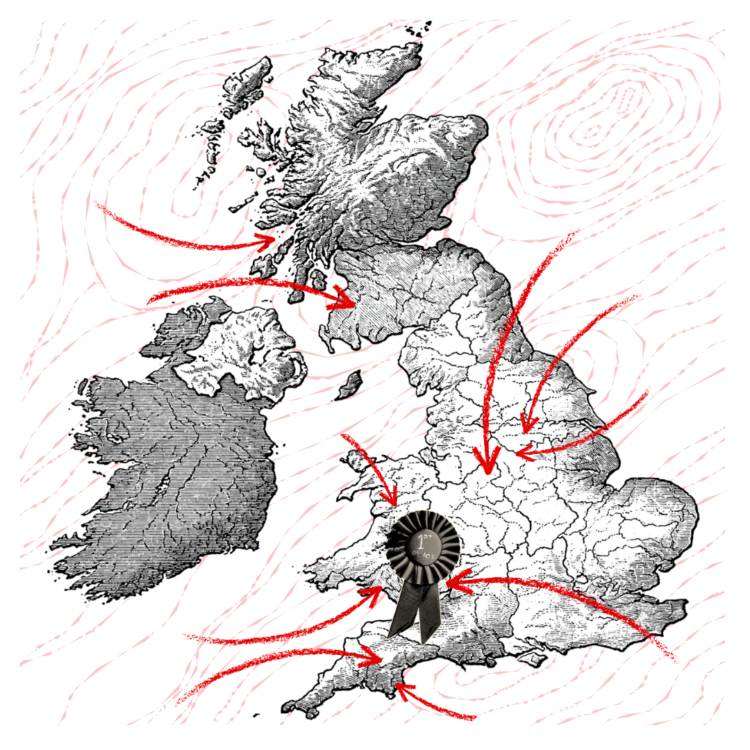
If you want a pumpkin spice latte from a corporate giant, don’t go to the Forest of Dean.
Our research revealed that this Gloucestershire gem is the only place in the UK with a 100% independent coffee scene. Not a single corporate chain in sight. Zilch. Just 36 pure, passionately run local spots serving real coffee to people who know the difference and not charging extra for single origin.
Close behind are West Devon (97.1%) and South Hams on the South East coast of Devon (97%), proving that the South West is actively rejecting the cookie-cutter corporate takeover. In fact, out of 361 local authorities, a staggering 359 of them are made up of at least 50% independent businesses. Death to Goliath.
The top 10 independent coffee capitals
(% of indie shops)
- Forest of Dean – 100%
- West Devon – 97.1%
- South Hams – 97%
- Argyll and Bute – 96.7%
- Derbyshire Dales – 96.6%
- Rotherham – 96.6%
- East Ayrshire – 96.4%
- Neath Port Talbot – 95.8%
- Staffordshire Moorlands – 95.4%
- Powys – 94.9%
The corporate hotspots
To the other side of the coin. We wanted to see who is relying heavily on the predictable safety net of the big chains.
Quelle horreur – the City of London takes the crown. Over half (53.2%) of its massive 237 coffee shops are corporate-owned. It turns out hurried city commuters value speed and predictability over soul and tax contributions. Crawley follows closely in second place, with 51.2% of its coffee options tied to a major brand.
The top 5 chain-dominated areas
- City of London Corporation – 53.2%
- Crawley – 51.2%
- Hillingdon – 48.7%
- Mansfield – 47.2%
- Westminster – 46.8%
Coffee obsession: The UK’s true caffeine capitals
When we look at sheer numbers, huge cities always win. But that’s lazy data. To find out where coffee actually dominates local culture, we looked at density: what percentage of an area’s entire food-and-drink scene is purely dedicated to coffee shops? If you think London rules the roost, think again. The data proves that a university city in the South West takes the crown.
A whopping 14.74% of all food and drink spots in Exeter are coffee shops, narrowly beating out the City of London (14.72%). Whether it’s students cramming for exams or locals hiding from the fabulous British weather, Exeter is officially the most caffeine-committed spot in the country.
London boroughs like Waltham Forest, Richmond-Upon-Thames, and Camden heavily dominate the rest of the top rankings, proving that the capital’s coffee addiction extends far beyond the corporate suit-and-tie crowds of the financial district.
The top 10 areas with the highest coffee shop density
- Exeter City – 14.7%
- City of London – 14.7%
- Waltham Forest – 14.7%
- Richmond-Upon-Thames – 14.1%
- Halton – 14%
- Camden – 13.8%
- Oxford City – 13.6%
- Watford – 13.3%
- Edinburgh – 13.1%
- Crawley – 12.8%
Coffee desertion: The UK’s least caffeine-fuelled spots
In some places you can’t move for coffee shops, but other parts of the UK prefer to fuel and socialise by breaking bread. We’ve flipped the script and looked at the lowest density of coffee spots.
If you’re looking for a quick caffeine fix, you might want to avoid North Kesteven. This East Midlands district ranks as the ultimate coffee desert in the UK, with coffee shops accounting for just 5% of its total food venues.
Hartlepool follows closely in second place at 5.03%, with the Welsh coastal hub of Pembrokeshire taking third at 5.23%. Despite Pembrokeshire boasting a massive total of 1,472 food-service premises, only 77 of them are coffee shops.
Coffee queues: Where you’ll be served instantly vs. where you’ll be waiting forever
We calculated the number of coffee shops per 100,000 people to find the UK’s caffeine deserts. Power be to the poor souls trying to get their morning fix in Slough.
The long wait: Where you should invest in that espresso machine
- Slough – 19.1 coffee shops per 100k people
- Barking and Dagenham – 22.8 coffee shops per 100k people
- East Renfrewshire – 23 coffee shops per 100k people
Why did we do this?
We’re an SEO and performance marketing agency. Why would we give an F about flat whites in Devon?
We are not keen on following the masses. Most agencies see a crowded market and tell you to do what everyone else is doing. We would rather dig into the messy, raw data to find the gaps, the anomalies, and the competitive advantages that everyone else is missing. Exactly what we do for our clients, too.
This research proves that even against massive, multi-million-pound corporate marketing machines, independents can dominate the landscape if they have the passion and the local grit. Out of 32,957 coffee shops in the UK, 25,415 are independently owned.
Whether you’re running a coffee shop in the Forest of Dean or a tech business trying to take down a global conglomerate, the lesson is the same: You don’t need the deepest pockets to win. You just need to know your audience, own your space, and use the data.
The boring (but important) methodology bit
We don’t make things up. Here is how we got the numbers:
- The source: Raw data extracted from the official Food Standards Agency (FSA) and Food Standards Scotland (FSS) databases.
- The Filter: We analysed establishments registered under food-service codes (cafes, coffee shops, snack bars) and cross-referenced them against a verified master list of major national and international coffee chains and franchises.
- Definitions: Chain = a corporate brand or widespread national franchise. Independent = a locally owned, single-location business or regional micro-chain.
- Note: Data reflects active registered listings at the time of analysis.
Want to check our homework? Go ahead, we run towards scrutiny. Here’s all the data.