








Our headline today – it seems like for the best part of a year, Google has been incorrectly logging impressions. Oh dear. Elsewhere, they’re cracking down on spam reviews across Maps, and have sunsetted Dynamic Search Ads in favour of AI Max, a move we saw coming since 2025. Snapchat tries to make a play for insurance companies, and OpenAI introduces CPC to ChatGPT. Here’s what you need to know from April.
SEO
1. Google has been incorrectly logging impressions since last year
Amidst the chaos of increasing impressions and dropping clicks as AIO presence increased last year, Google was unknowingly reporting impressions incorrectly in Google Search Console.
The self-reported logging error means that impressions data has been inaccurate since 13th May 2025. Whoops. In an update posted on 3rd April, Google said:
“A logging error is preventing Search Console from accurately reporting impressions from May 13, 2025 onward. This issue will be resolved over the next weeks; as a result, you may notice a decrease in impressions in the Search Console Performance report.”
They claim this only affected impressions and CTR – something to keep in mind if you notice anomalies or drops when reviewing the latest month’s stats.
Source: Search Console Help
2. Say goodbye to spam reviews as Google cracks down on Maps
Google has announced three new updates to how they are protecting businesses and searchers on Google Maps, great news for business owners who rely on local SEO. Expect to see less spam, fake reviews, and unhelpful edits. In short, the changes are:
- Fake edits will be caught faster – Google are using Gemini models to automatically detect fake or unhelpful edits that violate their policies
- Review scams will be stopped – systems can now detect scam patterns more efficiently before they go live, and spikes in reviews will lead to them being removed faster
- Business Profiles will be easier to manage – email alerts will go out to business owners when edits suggested by users or their own systems, giving them a chance to review them before they go live
These changes should make Google Maps more trustworthy, and less easy to manipulate.
Source: Google: The Keyword
3. Websites using back button hijacking have been given their marching orders
This is a long overdue bit of news that sees website users everywhere breathe a collective sigh of relief. Google has announced that websites using back button hijacking techniques have until the 16th of June to remove the offending features, or they will be in the firing line for a manual spam action or an automated demotion.
What is back button hijacking?
Back button hijacking is when a website interferes with browser functionality. When a website user clicks their browser’s ‘back’ button, they are held on the page, re-directed to another one on the website that they didn’t previously visit, or are served a pop-up.
Certain Google AdSense ad types have potential to trigger these organic penalties
The penalties could have a knock on effect for websites using Vignette Ads with a back button trigger enabled. There has been no official word from Google on this, but as this ad type uses the same functionality of preventing users from navigating away from a page, it’d be wise to switch them off to avoid killing your organic search presence.
The message is clear: put user experience first, or suffer the consequences.
Source: Search Engine Land
4. Updates have been made to ‘Read More’ link best practice documentation
Google has updated its guidance on ‘Read more’ deep links in Search, giving advice on how to make sure they work properly. Seems like a small element to worry about, but in an increasingly busy SERP, anything that helps you to stand out is worth going after.
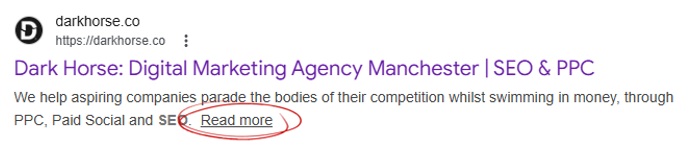
It recommends that linked content is directly visible on load (not hidden in tabs/accordions – which is often done for on page elements like FAQs) and that pages don’t disrupt deep links by forcing scroll resets or removing URL fragments.
Source: Search Engine Land
5. Introducing Google Data Studio (formerly known as Looker Studio… formerly known as Data Studio)
Google has made the decision to ‘re-brand’ Looker Studio to Google Data Studio. Those who just got used to calling the platform Looker Studio after the initial switch from Google Data Studio a few years ago may experience deja vu, whiplash, and dizziness. If symptoms do not pass within 24 hours, please consult your SEO agency.
Framed as strategic brand evolution, Google said:
“We are sharing the next step in our mission to solve this challenge and reintroducing a beloved and familiar name, Data Studio (formerly Looker Studio).”
New platform features
You’ll be glad to hear that it’s not just the name that is changing, Google has also shared that several new features are to be introduced, including:
- Gemini Integration: AI assistance to help create calculated fields, generate report summaries, and build charts using natural language.
- Conversational Analytics for All: The ability to “chat” with your data and ask questions in plain English is now available to all users (previously restricted to Pro).
- BigQuery Data Agents: Direct access within Data Studio to AI-driven conversational agents built in BigQuery.
Alongside mobile app access, a refreshed home page, and Gemini powered automatic slide generation.
Source: Google Cloud
Digital PR
1. HuffPost UK adopts Taboola’s ‘DeeperDive’ AI
HuffPost UK has become one of the first major publishers to integrate DeeperDive, a generative AI “answer engine” developed by Taboola that sits directly on their website. Unlike generic chatbots, DeeperDive only uses the publication’s own verified reporting and editorial archives to provide conversational answers to reader queries.
The tool is designed to keep readers on the site by providing instant, contextual answers to complex questions, rather than forcing them back to a search engine where they may go elsewhere for answers. It also allows the publisher to insert contextually relevant adverts directly into the AI-generated responses to create a new revenue stream.
This move represents a shift in the media’s relationship with AI, now using it to keep up with LLMs whilst relying on the authority and trust they’ve built as a news title. For Digital PRs, this reinforces the importance of coverage on high-authority sites. It suggests a future where “Search” doesn’t just happen on Google, but within the articles themselves. We may need to adapt our content to be more “extractable” by these on-site AI agents, focusing on clear, factual summaries that the engine can easily pull into its answers.
This is also a potential new avenue for earned media attribution; if a brand is mentioned in an AI answer on HuffPost, it indicates a level of authority that a standard banner ad simply cannot replicate.
Source: JournalismUK
2. Google Search expands ‘Personal Intelligence’ to Chrome
Google has officially expanded its “Personal Intelligence” feature to Gemini in Chrome, allowing the AI to integrate data from a user’s Gmail, Photos, and past purchase history directly into the browsing experience. This means search results are becoming hyper-personalised; for example, if a user searches for “best running shoes,” Google may prioritise brands they have previously bought or mentioned in emails, rather than just the most authoritative SEO result.
Simultaneously, a study from BrightEdge revealed that AI Overviews (AIO) now appear in roughly 48% of search results, a massive 58% increase year-on-year. The overlap between traditional “Top 10” organic results and the citations used in AI Overviews is surprisingly low in some sectors (only 11% in Finance), meaning ranking #1 on Google no longer guarantees being the cited source in the AI answer.
The rise of Personal Intelligence makes “one-size-fits-all” SEO harder to track. Digital PR must now focus on building long-term brand familiarity so that the brand is already part of the user’s “personal data ecosystem.” The low overlap between Top 10 rankings and AI citations proves that Digital PR is more important than ever as part of your performance marketing strategy. AI models often bypass traditional “SEO-optimised” pages in favour of clear, factual, and authoritative expert commentary found in news articles.
Source: Google
3. The 2026 State of Digital PR: the ‘Agentic’ shift
The 2026 State of Digital PR Report has highlighted a significant shift in how press releases are used, with 85% of PRs now utilising them specifically to “seed” brand narratives for AI training. Google CEO Sundar Pichai recently described the future of Search as an “Agent Manager,” where search engines don’t just show links but execute tasks and summarise complex information on behalf of the user.
The report finds that Digital PR teams are moving closer to SEO departments (53% now work together daily), while the gap between traditional PR and Digital PR continues to widen. There is a new emphasis on “Narrative Integrity”, ensuring that the information about a brand across the web is consistent, as AI models are increasingly sensitive to conflicting data points.
AI models cross-reference data from multiple sources to verify facts; if your brand messaging is inconsistent across the web, AI assistants may flag the information as unreliable and omit your client from their answers in favour of more “consistent” competitors. As we move from link-building to Generative Engine Optimisation (GEO), a unified digital narrative ensures that every piece of earned media acts as a clean data source for LLMs, directly influencing how the brand is described in automated summaries.
Source: BuzzStream
PPC
1. Open AI adds CPC to ChatGPT
OpenAI is shifting ChatGPT ads from impression-based pricing to CPC, nudging it closer to a performance model that anyone in Google Ads will recognise instantly. ChatGPT is no longer just a place for awareness. It is starting to look like a proper acquisition channel where you only pay when someone clicks.
In theory, that makes ROI easier to track and compare with Search. In reality, it also tells you where this is going. A new high-intent surface, a familiar pricing model, and keep in mind that early access usually does not stay cheap for long.
Source: Search Engine Land
2. Google Ads Demand Gen campaigns hit by review delays
Demand Gen campaigns are seeing extended review delays, with some ads stuck in approval for up to a week while Google works on a fix. For a channel built on rapid testing, that is not just annoying, it breaks the rhythm entirely.
When reviews slow down, so does everything else. Iteration stalls, launches slip, and suddenly your idea of “agility” depends on how fast Google feels like moving. You are not optimising if nothing is going live.
Source: Search Engine Land
3. Google updates Dynamic Search Ads to AI Max
Google is continuing its rollout of AI Max, with older formats like DSA and automated assets being pushed towards migration later in 2026. Another quiet step in the same direction, and one Dark Horse foresaw last year.
This is less about updates and more about removal of choice. Keyword-led targeting keeps shrinking while AI-led matching takes over. Whether that is efficient or just less controllable depends on how much you liked having control in the first place.
Source: Google Ads & Commerce Blog
4. Performance Max import improvements from Google Ads
Microsoft has made it easier to import Performance Max campaigns from Google Ads, particularly those using New Customer Acquisition goals. In short, you can now copy and scale setups across platforms with less manual rebuild work.
It sounds helpful, and it is. But it also makes cross-platform duplication almost too easy. Less friction means more replication, whether or not the strategy actually suits both platforms.
Source: Microsoft Ads Blog
5. Expansion of AI-led optimisation and automated campaign suggestions
Microsoft continues expanding AI-driven recommendations and automated optimisation across campaign setup and management, pushing advertisers further into system led decision making.
The direction is consistent everywhere now. Less manual control, more platform interpretation. It is faster, cleaner, and easier to scale, but also harder to explain when performance shifts and you are not entirely sure what changed.
Source: Microsoft Ads Blog
Paid Social
1. TikTok adds new AI video generation to Symphony ad tool kit
TikTok has integrated ByteDance’s Seedance 2.0 model into its Symphony ad suite. The Dreamina Seedance 2.0 model can produce realistic, consistent video content from text prompts, and advertisers can also use images or reference clips as inputs alongside text. The model promises better quality and less manual effort. It improves product consistency across video, delivers more natural motion, and reduces the time spent fixing outputs.
AI-generated video brings genuine creative risks alongside its benefits. Audiences are quick to notice when human depictions look subtly wrong – awkward movement, unnatural expressions, or slightly off proportions can feel unsettling and erode trust in a brand. Beware the uncanny valley.
This might see creative production costs drop significantly. With polished AI video now built directly into the ad buying workflow, teams can align on creative concepts faster and at scale without relying on expensive shoots or external agencies, which is particularly useful for testing multiple ad variations.
On the other side, brand safety and creative review processes need updating. AI-generated video can subtly undermine brand trust if human or product depictions look slightly off – and audiences will notice before you do. Paid social managers should establish clear approval criteria for AI-generated assets before they go live, with particular scrutiny applied to any ads featuring people or recognisable products.
This is a sign to test the tool now, before competitors do. As AI video becomes common practice across platforms, early adopters who learn what works on TikTok (prompts, styles, and formats etc) will have a meaningful edge. It’s worth running controlled tests now rather than waiting for the technology to mature further.
Source: Social Media Today
2. Snapchat highlights opportunities for insurance brands
Snapchat’s audience is more insurance-savvy than you might expect. A survey of 1,513 US-based social media users found that 4 out of 5 Snapchat users already own at least one insurance policy, making them 1.4x more likely than non-Snapchatters to be policy holders. Every day’s a school day.
Snapchatters are highly receptive to switching providers and take action around life events. 82% of Snapchatters said they would consider changing insurance providers, and 77% reported adopting or changing a policy following a major life event in the past six months – making them 1.8x more likely than non-Snapchatters to have taken that kind of action.
Snapchatters were 2.6x more likely than non-users to think positively about insurance brands and products after encountering them on social platforms. This suggests the platform can do real brand-building work in a category not traditionally associated with social advertising
Insurance brands should seriously consider Snapchat as a performance channel, not just an awareness play. The combination of high policy ownership, openness to switching, and positive brand opinion after ad exposure makes this a stronger conversion environment than the platform’s reputation might suggest – especially for lead generation campaigns.
Life event targeting is the strategic sweet spot. The data points to Millennials and Gen Z on Snapchat being in active transition – moving home, buying cars, starting families. Paid social managers should build campaign triggers and audience strategies around these moments, mirroring the approach already used on Meta but applied to Snapchat’s unique audience profile.
This research was commissioned by Snap itself, which means it should be treated as directionally useful rather than fully independent. Before recommending a significant budget shift, paid social managers would be wise to run a low budget test to gauge demand.
Source: Social Media Today
3. Snapchat makes a push for Snapcodes as a marketing tool
Snapchat is actively promoting Snapcodes as a branded marketing tool for advertisers. Snapcodes have been available as an advertiser option since 2017, allowing brands to generate a custom, scannable QR code that Snapchat users can activate via their phone camera to access more information about a brand or product.
Snapchat’s pitch is that Snapcodes offer more than a standard QR code. Brands can place their logo inside a Snapcode, link them to dynamic experiences such as AR lenses, and access more analytics to measure performance – positioning them as a more engaging alternative to generic QR code generators.
The strongest use cases in this article are physical – packaging, retail windows, and the like. For clients running omnichannel campaigns, Snapcodes could add a measurable, interactive layer to marketing activity that standard QR codes can’t match, particularly when paired with AR experiences.
A logo in the centre of a QR code is a fairly modest innovation. What actually makes Snapcodes worth considering is the ability to land users directly into an AR lens or immersive Snap experience – which is likely to be especially effective for brands where product visualisation matters (fashion, beauty, food).
Snapcodes are only scannable via Snapchat, which limits their audience considerably compared to a standard QR code readable by any phone camera. For clients targeting younger, Snapchat-native audiences this could be worth testing.
Source: Social Media Today
4. Report shows document posts on LinkedIn see more engagement
Document posts drive the highest engagement on LinkedIn, outperforming both image and video. This finding comes from Socialinsider’s 2026 LinkedIn Benchmarks report, which analysed 1.3 million posts from over 16,000 business pages between January 2024 and December 2025. This makes LinkedIn a notable exception to the short-form video dominance seen across almost every other platform.
The data also shows that multi-image posts generate the most likes, but that doesn’t necessarily mean they drive the most overall engagement. The report notes that if users focus on optimising for likes, they may end up posting less engaging content overall, which could impact broader performance.
For B2B businesses, document-style content is worth building into the LinkedIn content strategy – not just organically, but as a paid format too. LinkedIn’s Document Ads mirror this carousel PDF format and remain relatively underused compared to single image or video ads.
The distinction the report draws between likes and engagement is a useful reminder for client reporting conversations. If a client is measuring LinkedIn success purely by likes or reactions, they may be optimising for the wrong thing. Paid social managers should ensure reporting frameworks capture deeper engagement signals (saves, comments, shares, and dwell time) especially on LinkedIn where professional intent matters more than passive scrolling.
Original research and insights are the currency that makes document posts work. A PDF carousel is only as good as the content inside it. The format advantage won’t save a generic post. For clients with access to proprietary data, case studies, or sector insights, this is a strong argument for packaging that content as a document post rather than a blog link.
Source: Social Media Today
If any of this came as a surprise and might affect your bottom line, pick up the phone. With the backing of Manchester’s top minds in performance marketing, you won’t be caught out.